
Elements
Maintain
Maintain is the build orchestrator for Land, providing shell scripts for debug and release builds, GritQL queries for automated refactoring, and a turbo.json task graph - it does not need to be recompiled when changed.
Maintain is the build orchestrator for the Land project. It coordinates shell scripts, a Rust CLI with embedded Rhai scripting, and a Turborepo task graph to produce deterministic builds across all Land elements. Unlike Mountain, Cocoon, or Rest, Maintain does not need to be recompiled when its source changes - it is a build wrapper, not a compiled artifact that runs inside the editor.
What Maintain provides
| Capability | Description |
|---|---|
| Shell script entry points | Debug/Build.sh, Release/Build.sh, SignBundle.sh - the commands developers and CI run |
| Rhai scripting engine | Embedded rhai interpreter for flexible build logic and custom automation without shell portability concerns |
| TOML / JSON5 editing | Type-safe, non-lossy editing of Cargo.toml and package.json files via toml_edit and json5 |
| turbo.json task graph | Defines globalEnv, task dependencies, and parallel execution across all Land packages |
| GritQL queries | Automated refactoring patterns for bulk code transformations across the codebase |
| CI/CD configuration | Pipeline definitions for building and signing on each supported platform |
Architecture
Maintain is a Rust binary and library. The CLI layer accepts subcommands and delegates to the Rhai scripting engine or direct build functions. Configuration editing is performed through toml_edit and json5 for structured, non-lossy modifications to project configuration files.
 ## Key Modules
| Path | Description |
|---|---|
Source/Library.rs | Binary entry point; wires together CLI, logging, and error handling |
Source/Build/CLI.rs | clap-based CLI with subcommands: debug, release, profile, dev |
Source/Build/Definition.rs | Build group definitions: which elements to build, in what order |
Source/Build/Fn.rs | Core build function dispatch: clean, compile, link, post-process |
Source/Build/Process.rs | Child process spawning with stdout/stderr capture and exit code handling |
Source/Build/TomlEdit.rs | Non-lossy TOML editing for Cargo.toml version bumps and dependency changes |
Source/Build/JsonEdit.rs | JSON5-aware configuration editing for package.json and .json5 files |
Source/Build/Pascalize.rs | PascalCase ↔ words conversion utilities for naming convention enforcement |
Source/Build/GetTauriTargetTriple.rs | Detects current Rust target triple for SideCar binary selection |
Source/Build/EnvironmentResolver.rs | Resolves environment variables with fallbacks for build-time configuration |
Source/Build/Logger.rs | Colored terminal output using the colored crate |
Source/Build/Error.rs | Unified error type for build failures |
Source/Build/Rhai/ConfigLoader.rs | Loads and parses Rhai build configuration scripts |
Source/Build/Rhai/ScriptRunner.rs | Executes Rhai scripts within the build context with Land API bindings |
Source/Build/Rhai/EnvironmentResolver.rs | Exposes environment variable resolution to Rhai scripts |
Data Flow
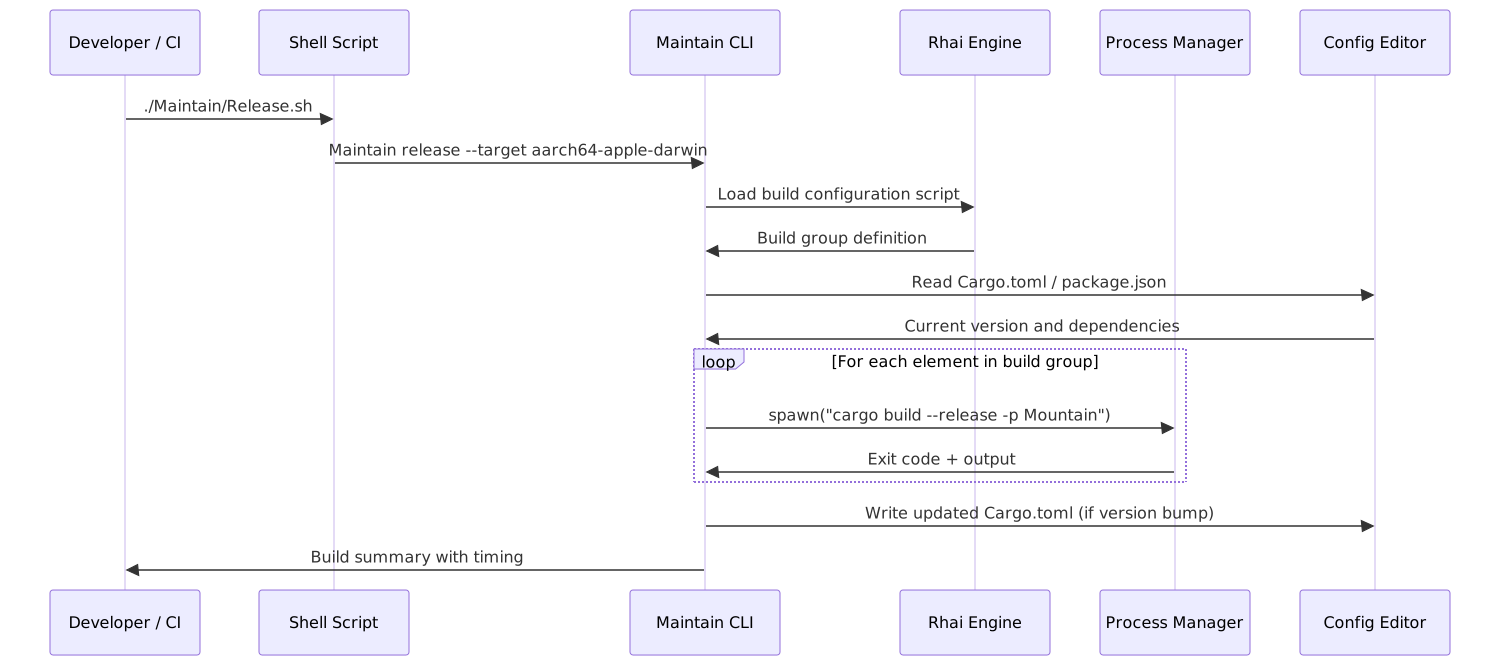 ## Integration Points
| Connecting Element | Direction | Mechanism | Description |
|---|---|---|---|
| Mountain | Build target | cargo build subprocess | Maintain compiles Mountain as part of the debug/release build group |
| Air | Build target | cargo build subprocess | Air daemon compiled alongside Mountain |
| Echo | Build target | cargo build subprocess | Echo scheduler compiled as a dependency of Mountain |
| Rest | Build target | cargo build subprocess | Rest compiler binary built for use by Output |
| SideCar | Build target | cargo build subprocess | SideCar Download tool compiled and run as part of setup |
| Output | Build trigger | pnpm run prepublishOnly subprocess | Maintain triggers TypeScript builds via pnpm |
| Wind / Sky | Build trigger | pnpm run prepublishOnly subprocess | Frontend packages built through Turborepo via Maintain |
Configuration
| Option | CLI Flag | Description |
|---|---|---|
| Build mode | debug / release subcommand | Controls --release flag and optimization level |
| Target triple | --target | Rust target triple for cross-compilation |
| Element filter | --element | Build only a specific element rather than the full group |
| Script path | --script | Override the default Rhai build configuration script |
| Verbosity | --verbose | Enable detailed subprocess output logging |
Shell scripts
The primary entry points are shell scripts in Element/Maintain/:
| Script | Purpose |
|---|---|
Debug.sh | Full debug build of all elements |
Debug/Build.sh | Debug build: sets up env vars, runs tauri build --profile debug-electron, then calls SignBundle.sh |
Debug/Run.sh | Launches the built debug binary with Trace, Record, and other dev env vars |
Debug/Wind.sh | Builds and watches only the Wind TypeScript service layer |
Debug/All.sh | Debug all components including frontend |
Release.sh | Optimized release build with all elements |
Script/SignBundle.sh | Ad-hoc re-sign of the .app bundle using xattr -cr and codesign |
Dev-Mountain.sh | Hot-reload development mode for Mountain only |
Profile.sh | Release build with profiling instrumentation enabled |
Why Maintain does not need rebuild
Maintain’s shell scripts are plain sh - they run directly on any POSIX system without compilation. The Rust Maintain binary is a build helper CLI that is compiled once and cached; it does not run inside the editor at runtime. Changes to the shell scripts take effect immediately on the next invocation. Changes to turbo.json take effect on the next pnpm command. Only changes to the Rust source under Source/Build/ require cargo build -p Maintain.
Important
Never run cargo build -p Maintain as part of a normal development loop. The shell scripts invoke the pre-built binary. Maintain is rebuilt only when its own Rust source is intentionally modified.
GritQL queries
Maintain ships a set of GritQL pattern files for automated refactoring. GritQL is a structural search-and-replace language for code that operates on ASTs rather than text. Land uses these queries for:
- Bulk renames of TypeScript identifiers across all packages
- Migration of import paths when element structure changes
- Enforcement of naming conventions (PascalCase filenames, single default export)
- Updating generated code when templates change
GritQL queries are stored under Element/Maintain/Query/ and can be run against any element in the workspace.
turbo.json task graph
The turbo.json at the workspace root defines:
globalEnv- all PascalCase env vars (BundleLevel,HotReload,Watch,TierIPC, etc.) that Turborepo passes through to child tasks- Task dependencies - which packages must build before others (e.g. Output must build before Sky)
- Parallel execution - tasks with no declared dependencies run concurrently across CPU cores
- Cache keys - inputs that, when changed, invalidate the Turborepo cache for a task
pnpm workspace management
Maintain works within the pnpm workspace defined at Land/package.json. All TypeScript packages use the workspace: protocol for cross-package dependencies. Maintain’s Source/Build/JsonEdit.rs handles non-lossy edits to package.json files when version bumps are required - it uses the json5 crate to preserve comments and formatting that JSON.parse / JSON.stringify would destroy.
Rust CLI
The Maintain Rust binary provides subcommands for cases where shell scripts are insufficient:
# Debug build of a specific element
Maintain debug --element Mountain

# Release build for a specific target triple
Maintain release --target aarch64-apple-darwin

# Override the Rhai build script
Maintain debug --script Custom/Build.rhai

# Verbose subprocess output
Maintain release --verbose
The CLI is built on clap and delegates to either the Rhai scripting engine or direct build functions depending on the subcommand.
Source files
| File | Role |
|---|---|
Source/Library.rs | Entry point, wires CLI, logging, and error handling |
Source/Build/CLI.rs | clap-based CLI with debug, release, profile, dev subcommands |
Source/Build/Fn.rs | Core build function dispatch: clean, compile, link, post-process |
Source/Build/Process.rs | Child process spawning with stdout/stderr capture and exit code handling |
Source/Build/TomlEdit.rs | Non-lossy TOML editing for Cargo.toml version bumps and dependency changes |
Source/Build/JsonEdit.rs | JSON5-aware editing for package.json files |
Source/Build/Rhai/ScriptRunner.rs | Rhai script execution with Land API bindings |
Source/Build/Rhai/ConfigLoader.rs | Rhai build configuration script loading |
Source/Build/GetTauriTargetTriple.rs | Platform detection for SideCar binary selection |